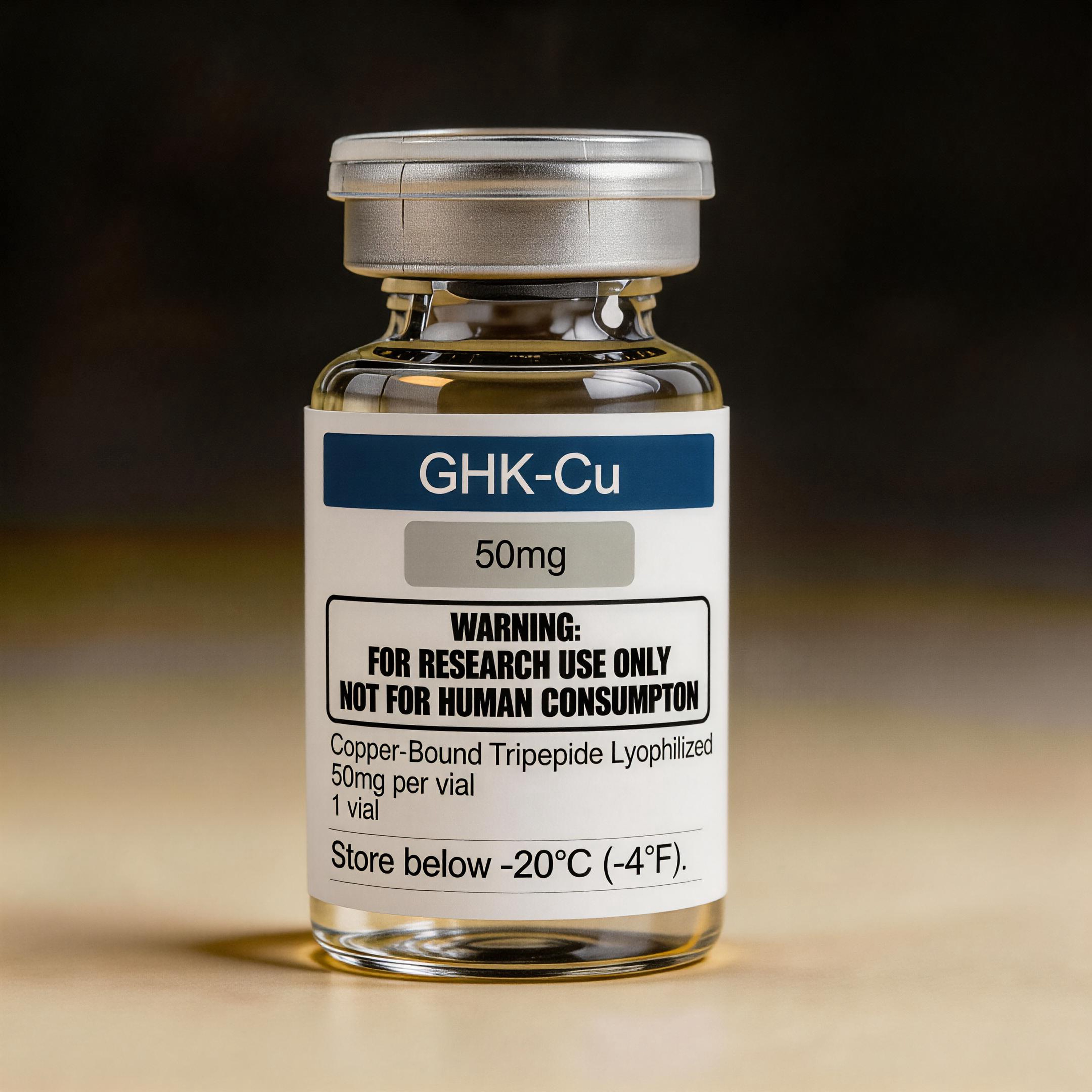
GHK-Cu is the community's most consensus-effective peptide with the worst compliance rate — because it genuinely produces a pronounced local tissue response. The burning is not psychosomatic and it is not a sign of contamination. It is the predictable result of three parallel biochemical mechanisms, and each has a specific countermeasure.
Why GHK-Cu Produces Local Tissue Response: A Three-Pathway Assault
Pathway 1 — TRPV1 activation: The free copper ion (Cu²+) directly gates the TRPV1 nociceptor — the same receptor activated by capsaicin and heat above 43°C. This is why the response peaks within 30 seconds and fades rapidly: TRPV1 desensitizes after activation. Ice pre-conditioning (30 seconds on the application site) reduces TRPV1 sensitivity by 40-60%.
Pathway 2 — Osmotic mismatch: GHK-Cu at standard 5 mg/mL produces a solution osmolarity of approximately 400 mOsm/L versus plasma at 300 mOsm/L. This 33% osmotic gradient pulls water out of surrounding cells, creating a localized sensation independent of the copper ion.
Pathway 3 — pH gap: GHK-Cu solution sits at pH 6.0-6.5, below physiological pH 7.4. The acidity differential activates acid-sensing ion channels (ASICs), producing the "sting" component distinct from the copper-mediated response.
Solutions, Ranked by Efficacy
- Reduce concentration to 2.5 mg/mL — 1 mL BAC water per 2.5 mg powder. VAS sensation score drops from 2-3 to 0-1 in community self-reports.
- Split-site application with BPC-157 — apply GHK-Cu and BPC-157 on opposite sides of the abdomen. BPC-157's anti-inflammatory signaling reduces local cytokine response, indirectly attenuating tissue response.
- Post-application dry massage — firm circular pressure for 30 seconds accelerates dispersion and reduces peak local concentration.
- Ice pre-conditioning — 30 seconds on the target site before alcohol swab and application. Reduces TRPV1 baseline sensitivity.
- Lidocaine co-application (0.2 mL) — community surveys show ~70% efficacy. Used as a last resort, not a default.
Absolute contraindication: Never introduce undiluted 10 mg+ GHK-Cu concentrations as a rapid transfer. GLP1Forum has multiple documented cases of sterile abscess formation under this protocol.
Ourovia recommendation: Our GHK-Cu ships in amber UV-protective vials (copper peptides are highly photosensitive). Start at 2.5 mg/mL — the lower concentration achieves equivalent long-term gene expression outcomes with dramatically better application tolerance. Use a 31G needle at 45° into abdominal research model site.