ExcelMale and GLP1Forum both rank CJC-1295/Ipamorelin as the most analytically validated entry point into growth hormone secretagogue research — but "appetite signaling response" is the #1 reason researchers discontinue prematurely. This is a protocol education failure, not a compound failure.
Appetite Signaling Response Is Pharmacodynamic Confirmation, Not a Secondary Observation
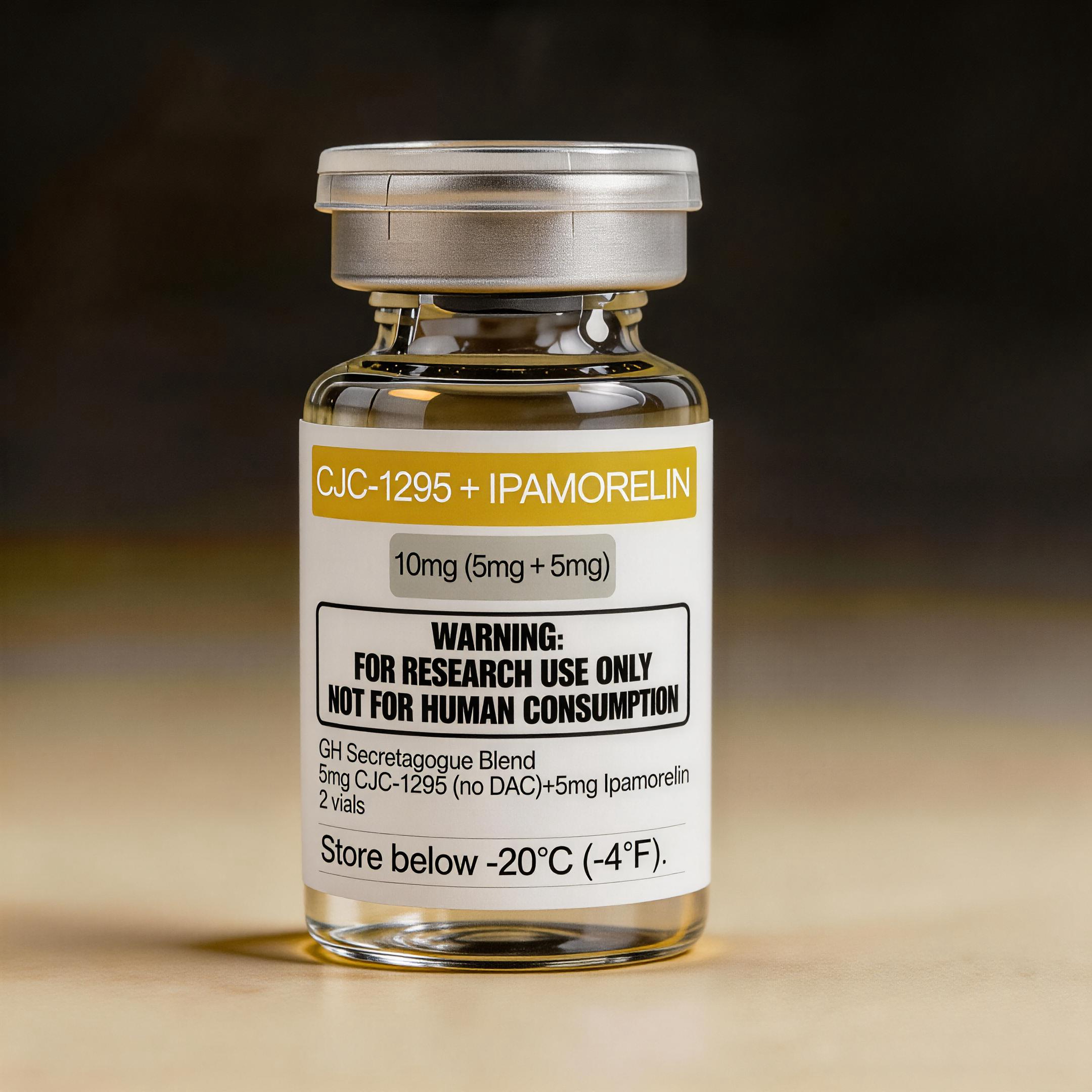
Ipamorelin is a selective GHS-R1a (ghrelin receptor) agonist. When it binds GHS-R1a, two things happen simultaneously: the anterior pituitary releases a pulse of growth hormone (the intended effect), and hypothalamic appetite circuits receive an "appetite signaling on" signal (the ghrelin-mimetic effect). The appetite signaling spike is direct evidence that your GHRP is pharmacologically active. It is the bioassay built into the mechanism.
The appetite signaling response diminishes significantly after 2-3 weeks as central GHS-R1a receptors downregulate in response to sustained agonism. Discontinuing at week one because you experienced appetite signaling is equivalent to stopping an exercise program because you felt sore after the first workout — the adaptation is the point.
Managing Appetite Signaling: Two Evidence-Based Strategies
- Co-apply with a GLP-1 agonist. Community data from GLP1Forum shows that co-applying Tirzepatide or Retatrutide reduces Ipamorelin appetite signaling response by approximately 70%. The GLP-1 appetite signaling suppression pathway directly antagonizes ghrelin-receptor-mediated appetite signaling at the hypothalamic level. This is a pharmacologically rational combination, not polypharmacy.
- Apply before rest cycle. The natural GH pulse coincides with the sleep-phase cortisol trough. Applying CJC/Ipa at this window aligns the pharmacological GH pulse with the endogenous rhythm, and the appetite signaling response occurs during sleep — you experience it minimally or not at all.
DAC vs No-DAC: The Community Has Spoken
| With DAC | Without DAC | |
| Half-life | ~7-10 days | ~30 minutes |
| Application frequency | 2x/week | 3x/day |
| Pituitary desensitization | High risk (3-6 months) | Minimal |
| Community rating | ⭐⭐⭐ | ⭐⭐⭐⭐⭐ |
The problem with DAC: Continuous GHRH receptor activation via the DAC-bound version causes somatotroph desensitization. By month 3-6, GH output per application declines measurably — and switching to the no-DAC version does not fully recover baseline sensitivity. The no-DAC version, despite requiring three daily applications, is the unequivocal community preference for protocols exceeding 8 weeks.
Ourovia recommendation: Use the no-DAC formulation for all protocols longer than 8 weeks. The three-times-daily application schedule is inconvenient, but a transfer pen (NovoPen or equivalent) with pre-filled cartridges simplifies the workflow considerably. Pre-fill cartridges with reconstituted CJC/Ipa, store at 2–8°C, and use within 24 hours of loading.